In modern commercial vehicles (such as heavy-duty trucks and buses) and commercial diesel engines, the coordinated operation of EGR (In-Cylinder Treatment) and SCR (Ex-Cylinder Purification) represents the ultimate strategy to balance power, fuel economy, Particulate Matter (PM), and Nitrogen Oxides (NOx).
The diesel engine industry has long faced a notorious dilemma: the trade-off between NOx and PM. If the combustion temperature inside the cylinder is high and explosive, the fuel burns completely, resulting in extremely low PM but skyrocketing NOx. Conversely, if an EGR system is used to forcibly lower the temperature to suppress NOx, the combustion becomes incomplete, causing a sharp increase in PM emissions.
How is this deadlock resolved? Modern commercial vehicles generally adopt a powerhouse combination strategy—”EGR + SCR”. Their division of labor and coordination logic are detailed below:
1:Core Division of Labor: Upstream Management vs. Downstream Cleanup
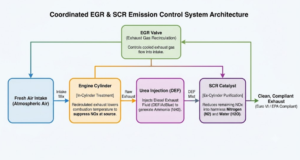
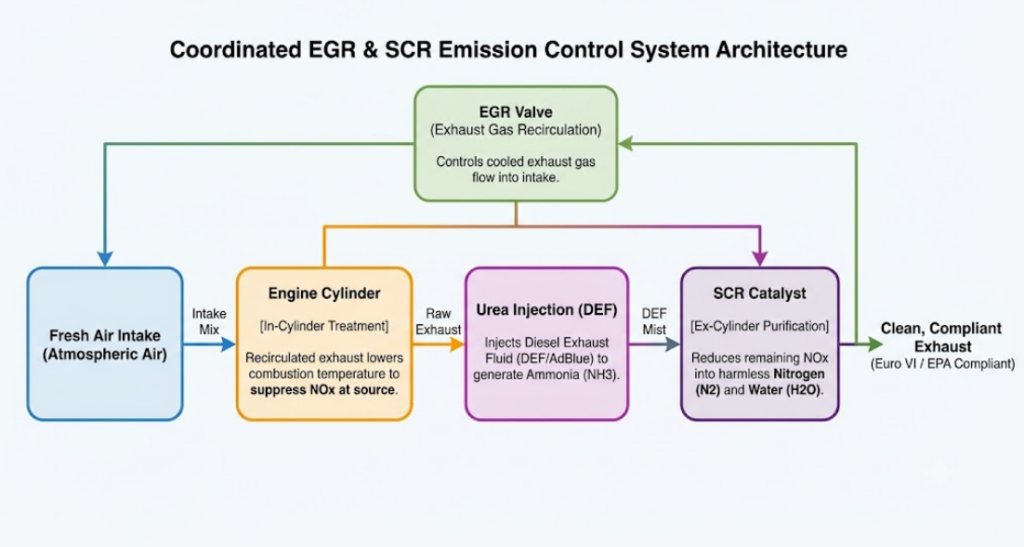
EGR (In-Cylinder Rough Filtration / The Vanguard): Its mission is to act as the first line of defense inside the engine cylinders. By introducing a portion of cooled exhaust gas to lower the combustion chamber temperature, it eliminates a significant portion of NOx at the source (cutting it by roughly 50%). This drastically mitigates the workload on the downstream SCR system and reduces diesel exhaust fluid (DEF/Urea) consumption.
SCR (Ex-Cylinder Fine Purification / The Rearguard): Its mission is to serve as the final gatekeeper inside the exhaust pipe. For any NOx that escapes the cylinders or is generated in large quantities during high-load operations, the SCR system injects a urea solution (AdBlue/DEF). In the presence of a catalyst, it reduces more than 90% of the remaining NOx into harmless nitrogen and water.
2:Dynamic Coordination: Trade-offs Based on Driving Conditions
The ECU (Engine Control Unit) acts like a conductor, dynamically tuning the operating ratio between the two systems based on the truck’s driving status:
| Driving Conditions | In-Cylinder Status | EGR Valve Status | SCR System Status | Coordination Logic |
|---|---|---|---|---|
| Low-Speed Urban / Traffic Jams / Idling |
Very low exhaust temperature (below 200°C). |
Highly Active (Open) | Inactive or Low Efficiency |
EGR takes the lead. Since the exhaust temperature is insufficient, the SCR catalyst cannot reach its optimal light-off temperature (spraying urea would cause crystallization). The EGR valve opens wide to suppress NOx directly inside the cylinder. |
| Highway Cruising / Moderate Load |
Combustion chamber temperature rises; exhaust temperature is optimal. |
Moderately Open | Highly Efficient | The Golden Pair. EGR participates moderately to control initial NOx while maintaining combustion efficiency. Meanwhile, the SCR operates in its peak temperature zone, efficiently absorbing residual NOx with highly economical urea consumption. |
| Hill Climbing / Overtaking / Heavy Load |
Extreme temperatures; maximum power output is urgently required. |
Fully Closed | Full Capacity (Increased Urea Injection) |
SCR fights alone. To deliver maximum torque, the EGR closes completely to intake 100% fresh air. The cylinder encounters high-temperature and oxygen-rich conditions, causing NOx to skyrocket. The SCR system compensates by boosting urea injection to handle the heavy cleanup in the exhaust stream. |
3:Generational Evolution of Technical Solutions
Two distinct paths have emerged in the technical evolution of commercial vehicles. In the earlier Euro V / National V eras, many manufacturers adopted the “High-Efficiency SCR” route (omitting EGR or minimizing its use) to avoid the complex cooling systems and high failure rates associated with EGR. This approach pursued ultimate combustion efficiency inside the cylinder (extremely low PM) and relied entirely on aggressive urea injection to treat the massive amounts of resulting NOx.
However, with the implementation of ultra-stringent standards like Euro VI (and similar Tier 2 Bin 5 / Tier 3 Bin 30 regulations), relying solely on downstream aftertreatment became cost-prohibitive due to massive urea consumption. Furthermore, it easily led to emissions non-compliance during low-speed urban driving when exhaust temperatures drop. Consequently, returning to the “EGR + SCR” combined strategy has become the most reliable and mainstream technical blueprint for modern commercial vehicles—where EGR saves urea costs for the fleet owner, and SCR safeguards the engine’s power output, working in perfect synergy.